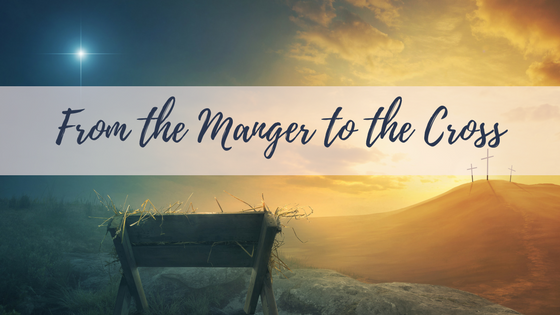
“For a Child will be born to us, a Son will be given to us; And the government will rest on His shoulders; And His name will be called Wonderful Counselor, Mighty God, Eternal Father, Prince of Peace.” Isaiah 9:6
It’s Christmas! And as I was flipping through the Bible to contemplate all the many Old Testament prophecies that point us to the birth of Jesus, a weirdly random memory popped into my mind. I was a seventh grader in my favorite class that year called “Mixed media.” (Now, I am within my fifth decade of life, so the “media” we explored in this class would only resonate with my generational peers.) The class taught students how to effectively communicate within the various forms of modern media—as a bourgeoning young writer and a tendency (like most middle-school girls) to be dramatic, you can imagine how much I loved this class. The assignment that bubbled up in my mind while looking into God’s Words about Christmas was this: We were tasked to choose a text for a dramatic reading, find appropriate accompanying music, and perform it in class.
Although my family was Catholic, and we didn’t read the Bible—that was for other people to read portions to us on Sundays—I did have a big children’s illustrated Bible in my possession. (If you grew up Catholic in the 1970s/80s, you can probably see in your mind’s eye what I’m talking about.) So, I chose for my reading one of the gospel narratives of the crucifixion of Christ—obviously highly dramatic. For my music, I was just looking for a piece that could match the drama of the words, with the right ebbs and crescendos. Somehow, in my 12-year-old obliviousness, I found “Carol of the Bells”—maybe because the timing was just before Christmas break, but I’m not sure. But I know that I didn’t give any thought to it being a Christmas song, it just felt like the right choice musically. And in my memorialized version of that classroom event, I slayed the assignment. Although my teacher gave me high marks on my recitation, she pinged me quite heavily on the fact that I chose a Christmas song while reading about an Easter event. These elements had no relationship, she said. Being ever the perfectionist, I was bummed to not have gotten a perfect mark, but I moved on…
Now, four decades later—and having been a follower of Jesus for the past three of those—I can look back on that memory recognizing a beautiful truth lost on both me and my teacher: There is nothing more connected in the history of the world than the two elements of my dramatic reading. My 50-something-year-old Biblically literate self would go back to class and dispute my teacher’s assessment, “No, ma’am,” I’d say. “The very point of Christmas is Easter.”
Fulfilling God’s plan from eternity past, as well as those prophetic OT writings, a virgin named Mary gave birth with her fiancé in a small cave meant to shelter animals (Isaiah 7:14; Luke 1:26-38). In a town—Bethlehem—whose name means “House of Bread”, God brought forth the Bread of Life (Micah 5:2; Luke 2:1-8). Jesus—who is God—removed His heavenly royal crown and wrapped Himself in flesh—Immanuel, God with us (Isaiah 7:14; Matthew 1:18-25). The Lion of Judah became the Lamb of God for the purpose of being slain on our behalf (Isaiah 53:7; John 1:29; Revelation 5:12). He was born fully man and fully God (John 1:14; Philippians 2:7; Colossians 2:9), to live the perfect life we could not, die a brutal death on a cross (accurately prophesied before crucifixion was invented, see Isaiah 53:1-12; Psalm 22) to pay the penalty we owe (Romans 6:23; Ephesians 1:7)…and to rise again triumphant over sin and death to reconcile this lost and broken world into right relationship with God (Isaiah 53:5; Romans 5:10-11; 2 Corinthians 5:18-19; Colossians 1:19-22) .
Friend, this is the paradox of Christmas. Yes, we celebrate with the angels (Luke 2:14-15) and sing, “Glory to God in the highest, and on earth peace…” But the peace declared by the angelic host doesn’t come at that time with the baby wrapped in swaddling clothes in the manger. This peace with God declared in the heavenlies was established 33 years later, when this man—dead and wrapped in grave clothes—walked out of His tomb in victory.
“Lord, may we celebrate Your glorious birth with a right view to why You came to earth—to make the way to peace with God through the death and resurrection for which You were born.”
For His Glory
Julianne Winkler Smith
TRBC Women’s Life
 trbccoffeebreak
Leave a comment